Chronology of Connecticut History
8500-7000 B.C.— Paleo-Indians begin to explore and hunt in present-day Connecticut.
3,000 B.C.— Archaic Period; Indians use a variety of stone tools for hunting and fishing.
1000 B.C.-1600 A.D. — Woodland / Ceramic Period; Indians establish villages and develop trade networks, as well
as ceramic and bow and arrow technology.
1614— Adriaen Block sails from Manhattan Island along present coastline of Connecticut, and up Connecticut
River as far as Enfield Rapids, trading with Indians en route; his explorations become basis of Dutch claim to
Connecticut.
1632— Edward Winslow, governor of Plymouth, visits Connecticut Valley to investigate Native American reports
of its fertility, possibilities as trading center.
March 19. Lord Say and Sele, Lord Brooke, and two others secure grant from Earl of Warwick to all land West
from Narragansett River (now Bay) to ‘South Sea’ (Pacific Ocean).
Governor Van Twiller of New Netherland, hearing of Winslow’s trip, purchases land at mouth of Connecticut
River from the Indians; he nails Dutch coat of arms to tree on Opint, later called Saybrook by English.
1633—
June 6. Dutch purchase land on present site of Hartford from Pequot Indians; they erect Fort of Good
Hope, establish a trading post.
July 12. Representatives of Plymouth propose to Massachusetts Bay Colony that they establish a joint trading
post on the Connecticut River.
John Oldham leads an expedition from Watertown, Massachusetts, explores and trades with Indians long
Connecticut River.
Sept. 26. William Holmes and small company of men representing Plymouth Colony sail up the Connecticut
River, erect a fortified house as a trading post on site of the present town of Windsor.
1634—
John Oldham and colonists from Watertown settle in Wethersfield.
1635—
First English settlers in Windsor arrive in summer.
Fort erected at Saybrook by Lion Gardiner.
Group from Dorchester, Massachusetts joins Windsor settlement.
1636—
Thomas Hooker and his congregation settle in Hartford in spring.
April 26. First General Court is held in Connecticut, at Hartford.
1637—
April. Wethersfield colonists are massacred by Pequot Indians.
War is declared on the Pequot.
May 11. General Court votes to raise levy of 90 men for Pequot War.
May 26. Capt. John Mason destroys Pequot fort at Mystic.
July 13. Great Swamp Fight ends Pequot War.
1638—
April. New Haven Colony established by John Davenport and Theophilus Eaton.
June. Earthquake shakes southern Connecticut.
1639—
January 14. Fundamental Orders of Connecticut, “the first written constitution,” is adopted by Freemen
of Hartford.
John Haynes is elected first governor of colony.
1640—
New Haven purchases Southold on Long Island from Indians; additional Long Island purchases are made
in the following years.
1643—
May 10. Connecticut joins in forming the New England Confederation.
1646—
John Winthrop, Jr., founds New London.
1650—
Peter Stuyvesant journeys to Hartford to place claim to Connecticut.
Arbitration results in agreement that Connecticut may retain most of Long Island, and that western boundary
shall not extend more than twenty miles east of Hudson River.
Code of laws drawn up by Roger Ludlow and adopted by legislature.
1654—
At request of England, Connecticut seizes Dutch trading post and fort at Hartford.
1655—
Governor Eaton revises New Haven code of laws.
1657—
Shipbuilding begins at Derby, on Housatonic River.
1660—
Uncas is besieged by Narragansett Indians and relieved by Colonel Christopher Leffingwell.
1662—
John Winthrop, Jr., obtains a charter for Connecticut.
1664—
Connecticut releases claim to Long Island to Duke of York in return for cancellation of his claim to
western Connecticut.
Shipbuilding begins at New London.
1665—
Union of New Haven and Connecticut Colonies completed.
The first division of any Connecticut town was Lyme’s separation from Saybrook.
1666—
County governments are set up.
1674—
Duke of York takes out new charter for New York, which includes western Connecticut, disregarding
boundaries defined in Connecticut’s charter.
1675—
July 11. Major Edmund Andros, governor of New York, demands surrender of fort at Saybrook;
however, as English flag flies from ramparts, he dares not fire upon it and departs.
1675-76—
King Philip’s War; colonial troops defeat Wampanoag Indians, ending war in Connecticut region.
1686-89—
Connecticut is part of the Dominion of New England.
1687—
Oct. 31. Sir Edmund Andros, having been appointed Governor-in-Chief of all New England, arrives at
Hartford and demands surrender of charter; document is hidden in Charter Oak.
1689—
Feb. 13. William and Mary are proclaimed King and Queen of England.
April 18. Andros is imprisoned.
June 13. Connecticut resumes government under charter and re-elects Robert Treat as governor.
1690—
Laws enacted to provide free schools in Hartford and New Haven.
1700—
The General Assembly orders the establishment of grammar schools in Hartford, New London, New
Haven, and Fairfield.
Towns with seventy or more families are required to operate schools for the entire year, while smaller towns only
had to operate them for six months.
Inhabitants of Rye and Bedford are obliged to submit to jurisdiction of New York, in accordance with terms of
agreement made with Duke of York in 1683.
1701—
Collegiate School (later Yale University) is founded at Killingworth (now Clinton).
1702—
Collegiate School is opened at Saybrook.
1708—
Saybrook Platform permits churches to join regional consociations.
1717—
Collegiate School is moved to New Haven, receives grant for buildings.
New Haven State House is built on the Green.
1718—
Collegiate School is renamed Yale College.
1727—
Oct. 27. Earthquake felt in Connecticut.
1731—
Disputed Connecticut/New York boundary line settled.
1733 —
The General Assembly uses money from the sale of western lands to supplement school funds.
1740—
Edward and William Pattison manufacture tin ware at Berlin.
1740s—
Height of religious “Great Awakening.”
1744—
Beginning of King George’s War; Connecticut raises quota of 1,100 men.
1745—
Louisburg is captured; Roger Wolcott of Connecticut is second in command of expedition, and leader of
Connecticut contingent.
1748—
End of King George’s War.
1755—
James Parker prints Connecticut Gazette in New Haven; it is the first newspaper in Connecticut.
1756—
Population is 130,612.
1763—
Brick State House erected on New Haven Green.
1764—
British enact Sugar Act, taxing the colonies.
Connecticut Courant (later Hartford Courant), is launched at Hartford by Thomas Green; it is oldest paper
continuously published in United States.
1765—
British enact the Stamp Act; sharp opposition to Stamp Act by many Connecticut groups like the Sons of
Liberty.
1767—
Parliament passes the Townshend Acts.
1773—
British pass Tea Act; it is the final stage in the crisis between the colonies and England. Colonies boycott
tea from the British East India Company; numerous “tea parties” take place throughout the colonies.
1774—
Population is 197,910.
Connecticut officially extends jurisdiction over Susquehanna Company area in Northern Pennsylvania.
Silas Deane, Eliphalet Dyer, and Roger Sherman represent Connecticut at First Continental Congress.
1775—
State sends several thousand-militia to Massachusetts in “Lexington Alarm.”
Connecticut men helped plan and carry out seizure of Fort Ticonderoga.
Connecticut organized more than two hundred soldiers, and eventually contributed 31,939 men to Continental
forces.
First gunpowder mill in Connecticut started in East Hartford.
1776—
Samuel Huntington, Roger Sherman, William Williams, and Oliver Wolcott sign the Declaration of
Independence on Connecticut’s behalf. The majority of Connecticut people support the Declaration.
Connecticut Committee of Safety appoint Seth Harding of Norwich as captain of Defense, sole ship of the
Connecticut Navy at that time.
1777—
British troops under General Tryon raid military stores at Danbury.
1778—
General Putnam’s troops establish winter quarters at Redding, Connecticut’s “Valley Forge.”
1779—
July. British troops under General Tryon raid New Haven, then burned Fairfield and Norwalk.
1780—
May 19. “Dark Day”; many colonists believe Day of Judgment is at hand.
1781—
Sept. 6. Benedict Arnold of Norwich leads British attack on New London and Groton, and burned New
London.
Washington and Rochambeau confer at Webb House in Wethersfield.
1782—
Population is 208,850.
1783—
Meeting of ten Anglican Clergy at Glebe House, Woodbury, leads to consecration of Bishop Samuel
Seabury and beginning of Protestant Episcopal Church in United States.
1784—
Act is passed providing for emancipation at age of twenty-five of all blacks born after March 1784.
Tapping Reeve founds America’s first school of law at Litchfield.
First cities are incorporated (New Haven, New London, Hartford, Middletown, and Norwich).
Governor Trumbull retires from governorship.
Connecticut relinquishes Westmoreland area to Pennsylvania.
1785—
First Register and Manual is published.
1786—
Connecticut cedes western lands, with exception of Western Reserve, to federal government.
1787—
Oliver Ellsworth, William Samuel Johnson, and Roger Sherman serve as Connecticut’s representatives at
Philadelphia Constitutional Convention.
1788—
First woolen mill in New England established at Hartford.
Connecticut ratifies U.S. Constitution and becomes the fifth state in the Union.
1789—
Oliver Ellsworth and William Samuel Johnson begin service as first United States senators from
Connecticut.
1790— Newgate, East Granby copper mine, made state prison.
Population is 237,946.
1792—
First turnpike road company, New London to Norwich, is incorporated.
First banks are established at Hartford, New London, and New Haven.
1796—
Old State House, designed by Charles Bulfinch, is completed in Hartford.
1795— Connecticut Western Reserve lands are sold; $1,200,000 is earmarked for establishment of State School
Fund.
First insurance company, Mutual Assurance Company of the City of Norwich, is organized.
1799—
Eli Whitney obtains his first federal musket contract; within next decade develops a system of
interchangeable parts, applicable to industries.
British troops raid New Haven, Fairfield, and Norwalk.
1800—
Population is 251,062.
1802—
Brass industry begins at Waterbury by Abel Porter and associates.
1806—
Noah Webster publishes first American dictionary in New Haven.
1808—
Construction begins of Enfield Bridge, first to span Connecticut River.
1810—
Population is 261,942.
P.T. Barnum is born at Bethel.
Hartford Fire Insurance Company incorporated.
Danbury manufacturing hats.
1812—
Joseph Barber starts Columbian Register at New Haven. In 1911, combined with New Haven Register.
1812-14—
War of 1812; Connecticut contributes 3,000 men.
Due to the war, new manufactures, especially textiles, boom.
1813— British blockade Connecticut ports, which stopped the shipping industry.
1814—
Hartford Convention held in Old State House.
1815—
First steamboat voyage up the Connecticut River to Hartford.
1817—
Federalists defeated by reformers in political revolution.
Thomas Gallaudet found school for the deaf in Hartford.
1818— New state constitution adopted by convention in Hartford and approved by voters; ends system of
established church.
1819—
Congress appropriated money for the first school for the deaf in the United States (located in Hartford).
1820— Population is 275,248.
Captain Nathaniel Palmer of Stonington discovers the continent of Antarctica. Two years later, Captain John
Davis of New Haven becomes first man to set foot on Antarctica.
1823—
Washington College (renamed Trinity College in 1845) is organized at Hartford.
1825—
July 4. Construction begins on Farmington Canal.
1826—
Boundary dispute between Massachusetts and Connecticut, dating from 1662, is finally settled.
1827—
“New” State House erected in New Haven; Ithiel Town, architect.
1828—
Farmington Canal is opened.
1830—
Population is 297,675.
First industrial union in country, New England Association of Farmers, Mechanics, and Other Workingmen, is
organized at Lyme.
Democratic Party started.
1831—
Wesleyan University in Middletown is organized.
Mutual Insurance Company of Hartford founded
1832—
Connecticut’s first railroad, Boston, Norwich, and Worcester, is incorporated.
1833—
Hartford and New Haven Railroad is incorporated.
1835—
Revolver patented by Colt.
Music Vale Seminary, first American music school, founded at Salem by Oramel Whittlesey.
1837—
Train runs on first railroad to operate in Connecticut, between Stonington and Providence, Rhode
Island.
1838—
Railroad completed between New Haven and Hartford.
1839-41—
The Amistad affair.
1840—
Population is 309,978.
Railroading begins.
1840s-50s—
Peak of whaling from Connecticut ports and especially New London.
1842—
Wadsworth Atheneum, Hartford, first public art museum, established.
1843—
Charles Goodyear develops vulcanizing process for rubber.
Civil rights of Jews protected through act guaranteeing equal privileges with Christians in forming religious
societies.
1844—
New York and New Haven Railroad is chartered.
Dr. Horace Wells uses anesthesia at Hartford.
1846—
Connecticut Mutual Life Insurance Company, the first life insurance company, chartered in Connecticut.
1847—
First American agricultural experiment takes place at Yale.
1848—
Dec. 29. First railroad cars run from New York to New Haven.
Slavery abolished in Connecticut.
1849—
Teachers’ College of Connecticut is established at New Britain, now Central Connecticut University
1850—
Population is 370,792.
1860—
Population is 460,147.
Lincoln speaks in several Connecticut cities.
1861-65—
Civil War begins; state furnishes thirty regiments and three batteries for total of 57,379 men; there are
about twenty thousand casualties.
William Buckingham wartime governor.
1868—
Connecticut gives land at Groton to U.S. Navy for a naval station in April.
1870—
Population is 537,454.
1870s—
Depression hits the colonies.
1871—
Samuel L. Clemens (Mark Twain) makes Hartford his home.
1875—
Hartford becomes the sole capital city.
1877—
First telephone exchange in the world opened in New Haven.
Columbia Bicycles founded by Col. Albert Pope.
1878—
First local assembly of Knights of Labor is organized at New Britain.
Aug. 9. Hurricane hits Wallingford.
1879—
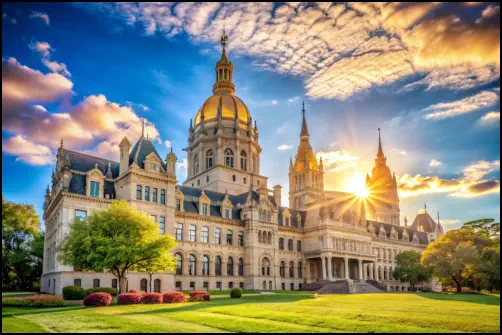
New Capitol building in Hartford completed; Richard Upjohn, architect.
1880—
Population is 622,700.
1881—
Storrs Agricultural College founded (became University of Connecticut in 1939).
1882—
National organization of Knights of Columbus is founded at New Haven.
1887—
State Federation of Labor is organized at Hartford.
1888—
March 12-14. Great blizzard hits area.
1890—
Population is 746,258.
Disputed election causes Morgan Bulkeley to continue two extra years as governor (1891-93).
1893—
Severe storm damages Connecticut Valley’s tobacco crop.
1897—
Manufacture of automobiles begun by Pope Manufacturing Company of Hartford.
1900—
Population is 908,420.
First United States Navy submarine, Holland constructed by Electric Boat Company.
1902—
Constitutional Convention held; proposed new constitution defeated in a statewide referendum.
1905—
General Assembly adopted public accommodations act ordering full and equal service in all places of
public accommodation.
1907—
First Boy Scout Troop in Connecticut established in East Hartford.
1910—
Population is 1,114,756.
Coast Guard Academy is moved to New London from Arundel Cove, Maryland.
1911—
Connecticut College for Women founded at New London.
1916—
German submarine Deutschland docks at New London.
1917—
U. S. Navy Submarine School formally established at New London Naval Base, Groton.
United States enters World War I.
State becomes munitions supply center, contributes 60,000 men.
1920—
Population is 1,380,631.
Brainard Field in Hartford becomes nation’s first city-owned airport.
University of New Haven founded.
1922—
Connecticut’s first radio station, WDRC, begins broadcasting in Hartford.
1927—
University of Bridgeport founded.
1930—
Population is 1,606,903.
Great Depression creates widespread unemployment; manufacturing is hard hit.
1932—
State’s unemployed number more than one hundred and fifty thousand.
St. Joseph College founded in West Hartford.
1934—
Feb. 19-20. Disastrous blizzard hits state.
1935—
Tercentenary Celebration takes place throughout State.
First streamlined train on New Haven System, Comet, makes initial run.
1936—
March 18-25. Connecticut faces disastrous floods.
1937—
Merit system is inaugurated in state departments.
Flood control contract is signed with other New England states.
1938—
Hurricane and floods produce heavy loss of life and property.
First section of Merritt Parkway opened.
1939—
First section of Wilbur Cross Parkway opened.
1940—
Population is 2,833,000.
Senator Maloney is nominated again by Democratic convention; Roosevelt endorses him.
1941-45—
World War II begins; state becomes important supplier of war materials.
Approximately 210,000 Connecticut men serve in World War II.
1941 —
Oldest house in Richmond is sold.
Governor Hurley submits budget to Assembly; he lists expenditures as highest in state’s history.
1942—
C. Bowles sets up statewide rationing system.
1943—
Mohegan Indians seek to sue state for 1675 and 1681 treaty violations.
Governor Baldwin seeks Monday closings of state offices to save fuel.
Thirty-six and a half- hour workweek is restored for state employees.
Survey is requested to determine state employees who can be released for war work.
Legislature chooses Robin as state bird.
General Assembly established Inter-Racial Commission, recognized as the nation’s first statutory civil rights
agency.
1944—
Circus Tent Fire Disaster.
1947—
Fair Employment Practices Act adopted outlawing job discrimination.
1950-52—
Approximately fifty-two thousand Connecticut men serve in Korean War.
1950—
Population is 2,007,000.
E. A. Adams Jr. is named to Governor Bowles’ staff; he is first African American appointed to administrative
post.
1951—
Bill is passed that bars General Assembly members from holding other jobs during term of office.
1954—
Commission to aid victims of Smith Act is created.
First atomic powered submarine, Nautilus, is launched at Groton.
1955—
Area is hit by floods from hurricane.
Shakespeare Memorial Theater Opened.
1957—
General Assembly approves Tuberculosis Commission on Chronically Ill, Aged and Infirm merger.
Dodd seeks nomination for senator.
University of Hartford founded.
1958—
One hundred and twenty-nine-mile Connecticut turnpike opened.
1959—
General Assembly votes to abolish county government (effective 1960), and to abolish local justice courts
and establish district courts.
1960—
Population is 2,535,000.
1961—
New state circuit court system goes into effect.
1962-75—
Approximately 104,000 Connecticut men and women served in the armed forces during the Vietnam
War.
1964—
Thomas J. Dodd and Abraham A. Ribicoff are elected senators.
General Assembly creates six congressional districts reasonably equal in population.
1965—
Census Bureau reports that Stamford is richest U.S. metropolitan area, according to 1960 census figures.
Constitutional Convention held. New Constitution approved by voters.
Hartford and New Haven begin school busing programs.
1966—
First elections held for reapportionment General Assembly under new constitution.
1967—
Sporadic violence flares in New Haven; four hundred and fifty people are arrested during five days of
looting, arson, and vandalism.
1969—
Museum of Natural History reports discovery of missing front half of Ammosaurus majir, a two
hundred-million-year-old dinosaur whose posterior remains had been in museum for eighty-five years.
Oct. 8. Republican town meeting in Westport passes resolution urging U.S. “to take immediate action” to
withdraw from Vietnam War.
Race riots break out in black and Puerto Rican sections of Hartford.
1970—
Population is 3,032,00.
Voters reject law giving voting rights to eighteen year olds.
Racial unrest between African Americans and Puerto Ricans escalates; one person is killed and twenty-five
others wounded in six days of street violence in Hartford.
1971—
Supreme Court rules unanimously that poor people cannot be jailed solely because they cannot pay fines.
1972—
Oct. 16. Supreme Court grants Connecticut stay of federal district court, voiding state’s new strict
abortion law; stay keeps law in force until Supreme Court decides on its constitutionality.
Nixon wins most electoral votes in Connecticut.
Under constitutional amendment adopted in 1970, General Assembly held first annual session since 1886.
Connecticut begins lottery.
1973— Connecticut becomes twenty-ninth state to ratify Equal Rights Amendment.
Newly created solid waste energy agency will establish statewide refuse disposal and recycling facilities; agency
has bonding power of $250 million.
1974— U.S. Representative Ella T. Grasso is elected governor; she is first woman in state’s history elected governor
and the first female governor in her own right (others succeeded husbands) in the United States.
1976—
Connecticut Health Department reports state’s birth rate, lowest in country in 1973 and 1974, dropped
still lower in 1975, even though number of childbearing women in State is at high.
Assembly approves $1.8 billion budget only slightly altered from that proposed to legislators by Governor Ella
Grasso.
1977—
Grasso calls for quick cuts in business taxes to hasten improvements already perceived in state’s economy.
1978—
All roads and highways close after some twenty-five inches of snow falls in less than thirty hours; nine
people die.
Common pleas and juvenile court becomes part of Superior Court.
1980—
Population is 3,108,000.
1982— Appellate Court created by Constitutional Amendment (Effective July 1, 1983).
1983— Governor William A. O’Neill is inaugurated.
Major road-building program is instituted to improve Connecticut’s almost twenty thousand miles of highway.
1984—
President Reagan’s landslide victory in Connecticut helps Republicans win one Congressional seat and
gain control of both houses of legislature for first time in decade.
Governor O’Neill names Ellen Ash Peters to State Supreme Court; Peters is first women to be chosen.
1986—
Riverboat cruises resume on Connecticut River for first time in twenty years.
1987—
Governor O’Neill calls on state to share current economic prosperity with all its people.
1988—
State Capitol building in Hartford, built in 1879, undergoes extensive renovations.
Attorney General Joseph Lieberman is elected senator, defeating Senator Lowell Weicker, Jr., by narrow margin.
Yale University students erect shanty on campus grounds in protest of University investments in South Africa.
A Yale alumnus torches shanty at alumni reunion; he is arrested and sentenced.
1989—
Connecticut College’s seeks to increase minority enrollment by bringing two hundred Hispanic and
African American students from eighth and ninth grade to campus for taste of high-powered academic and social
life for three weeks during summer.
1990—
In report issued August 16, Connecticut ranks fourth on list of states failing clean air checks by
Environmental Protection Agency.
1990 U.S. Census figures list Connecticut’s population at 3,295,669; a 6.1 percent increase from 1980 figures.
Eunice S. Groark, first woman elected Lieutenant Governor in Connecticut.
1991—
Connecticut’s state budget deficit is announced at $2.4 billion; Governor Lowell P. Weicker proposes tax
plan to revive state income tax, combined with large cuts in state’s sales tax.
June 30. Weicker’s tax plan is vetoed.
August 18-19. Hurricane Bob hits eastern seaboard; damage is worst in Massachusetts, Rhode Island, and
Connecticut. State’s cost from storm is estimated at forty million dollars.
City of Bridgeport files for bankruptcy.
First state income tax is passed, causing wide-ranging protests.
1992—
Hartford Courant wins Pulitzer Prize in journalism for reports by Robert S. Capers and Eric Lipton on
flawed mirror in Hubble space telescope.
Connecticut tops list for 1991 per capita income; it is 1.9 percent increase from 1990 figures.
U.S. Defense Secretary Richard B. Cheney announces plan to disband National Guard and Reserve units
through 1994; if plan is implemented, Connecticut will lose 27.1 percent (2,836) reservists.
Three-year recession results in high unemployment and decline in basic services; defense contractors are among
hardest hit.
1993—
Proposed plan to close New London Naval Submarine Base is rejected; base is one of eight on Defense
Department’s list scheduled to remain open.
Pratt and Whitney, unit of United Technologies Corp., announces plans to cut 6,700 jobs at Connecticut plants
through 1994; company manufactures jet engines.
1994—
Democratic State Representative Sam Gejdenson and former Republican State Senator Edward Munster
file appeals asking Connecticut Supreme Court to examine Second District election results; both allege voting
irregularities after final count gives Gejdenson victory by four votes out of about 185,000 cast.
State Supreme Court upholds reelection of Democratic Representative, Sam Gejdenson, after review of disputed
ballots; recount gives Gejdenson twenty-one votes over former Senator Edward Munster.
1995—
State senate rejects proposal by Governor John G. Rowland for casino gambling in Bridgeport; opponents
reject casino bid on grounds that casino will attract crime, traffic, pollution. Local pari-mutual industry, New York
State horse racing industry, and Atlantic City casino industry also oppose, fearing potential competition.
Godspeed Opera House in East Haddam wins Tony Award for outstanding regional theater.
1996—
Jan. Yale graduate teaching assistants (TA) end “grade strike” that began December 1995; participants
held back grades for students in fall 1995 semester, maintaining that TA’s were not recognized employees of Yale,
and that university participated in unfair labor practices. The strike ends after administration’s decision to strip
strikers of teaching positions if grades are not submitted by January 16.
State Supreme Court rules that racial segregation in public schools in and around Hartford capital violates state
constitution; although racial imbalance is believed to be result of demographic shift rather than intentional racial
discrimination, the Court orders state to take remedial measures.
1998—
Long Island Sound Policy Committee approves plan to reduce nitrogen in Long Island Sound waters
caused by sewage treatment plants along New York and Connecticut shoreline; both states will spend $650 million
in state and federal funds over fifteen years to upgrade plants.
Measure to restore 2,000 acres and one hundred river miles of habitat along shoreline by 2008 is approved.
2000—
ConnecCT Kids Website opens for Connecticut’s children.
In New London, the legislature voted on a referendum to ask voters to do away with the county sheriff system,
which has had a number of scandals attached to it in recent years. Senator Melodie Peters supports reforming the
sheriff system.
2001—
The city of New Haven honored local hero, James Hillhouse—an abolitionist that represented
Connecticut in Congress.
2002—
Yale researchers received a $7.1 million federal grant to study severe epilepsy. One of the hoped for
outcomes of this study is to reduce time required for epilepsy surgeries, which are usually done in two four-to-eight-
hour sessions.
2003—
In Hartford, bills were proposed to deal with the issue of second hand smoke. One proposal is to allow
towns and cities to regulate smoking in their respective jurisdictions. Another bill would create a statewide ban on
smoking in restaurants.
May. Two teenagers, Cassandra Stevenson (age fifteen) and Lauren Betancourt (age sixteen), were awarded
degrees at Connecticut colleges. Stevenson earned her bachelor’s degree in justice and law from Western
Connecticut State University. Betancourt earned her Bachelor’s degree in biological science from the University of
Hartford.
2005—
The United States Bureau of Indian Affairs (BIA) overturns the prior recognition of two Native
American tribes, Kent’s Schaghticoke Tribal Nation and the Eastern Pequots of North Stonington, in Connecticut.
The BIA and state officials agree that the tribes did not show continuous political and social existence dating to the
colonial era.
Knowledge Base for Connecticut Resources

Dictionary of United States History


Transcending the Past, Present and Future with Data Resources for Knowledge
© American Data Processing, Inc.