Connecticut History
Dr. Russell Lawson Chair; Division of General Studies, Bacone College
Long before Connecticut entered the Union on January 9, 1788 as the fifth state, several other groups claimed its
lands. At the time of first European exploration, it was the home of several tribes of Native Americans, including the
Algonquian-speaking Pequot, Mohegan, Niantic, Quinnipiac, and Wangunk. Dutch traders claimed the land for the
Netherlands in 1614. After their departure, the land became a colonial possession of the British Crown, and was
called the Connecticut (or River) Colony.
In 1614 Dutch navigator Adriaen Block discovered the Connecticut River and claimed the area for the
Netherlands. It was a fur-trading region until the mid-1620s, when the Dutch fortified several localities, including
the House of Hope, built in 1633 on the site of Hartford. Nonetheless, the area was soon abandoned.
English settlers from Plymouth Colony and Massachusetts Bay Colony established a number of settlements in the
region; in 1639, the Hartford, Wethersfield, and Windsor settlements joined together to form the Connecticut
colony.
The Puritans dominated the history of Connecticut’s colonial settlement. Puritan settlers came to the “New World”
in the early 1600s to escape oppression from the Church of England. Between 1630 and 1642, over twenty thousand
Puritans in about two hundred ships made the dangerous Atlantic crossing to New England. Although the major
thrust of this migration was into the Massachusetts Bay area, many early colonists eventually left the Bay area to settle
in the area called Quinnetukut by the Native Americans, or “place of the long river.”
Orthodox Puritans who were in accordance with Massachusetts Bay planted Connecticut’s earliest English
communities. By the mid-1630s, settlements had been established in Windsor, Wethersfield, and Hartford. The
Reverend Thomas Hooker, a guiding force behind the early settlement in Hartford, emerged as the spiritual leader of
the river towns. Meanwhile in 1637 two boatloads of English Puritans, led by the Reverend John Davenport and
merchant Theophilus Eaton, settled at the harbor of Quinnipiac. The New Haven Colony eventually included the
towns of Milford, Guilford, Branford, Stamford, and Southold. Although New Haven initially sought to maintain
itself as an autonomous colony, by 1665 economic issues and a fear of becoming incorporated into Anglican New
York drove the community to join with the Connecticut Colony.
Puritanism was the religious, moral, social, and political force that determined the course of the new society. Central
to Puritan theology, and the principle that contributed significantly to the evolution of Connecticut’s settlers, was
the concept of “the Elect.” Puritans believed that few people would ever achieve a state of grace. Following the
theology of John Calvin, they believed that Adam and Eve’s fall in Eden doomed humanity to suffering, corruption,
and death. Calvin’s theology qualified this despairing view of the human condition, promising salvation to a select
group of men and women, the “Elect,” who would undergo a spiritual rebirth. Although the Puritans knew, that the
number of the “Elect” would be small, they were nevertheless hopeful that they would be counted among the holy
group. This perception of life resulted in the Puritan constantly searching for evidence that he or she were among the
spiritual elite. The Puritans were driven to live life as a time of trial during which purity of thought and deed might
signal the presence of God’s saving grace.
Puritan society was thus organized around the leadership of the “Elect.” Thomas Hooker, considered the father of
Connecticut Puritans, left Massachusetts Bay with his flock. After they settled in the state, Hooker encouraged the
settlers to participate more in the policy-making of their government. In a sermon preached in May 1638, Hooker
laid down the principle upon which the colony’s framework of government was based. The Fundamental Orders
maintained that the foundation of government should rest upon the consent of the people, and should be expressed
through the electoral process. Yet despite the fact that the Fundamental Orders clearly called for separation in
Connecticut of civil privilege from church membership, a system of government was erected based on membership in
and leadership by the Puritan Congregational Church.
Connecticut’s leaders thus erected barriers to mass participation in government. Membership was limited to adult
males who owned a freehold plot of land, maintained a conservative image, and were regarded as acceptable by other
members. Connecticut’s early leaders were all devoted Congregationalists who came from families with the largest
land holdings. They were most often graduates from Yale, and were active in law and business. Leading families not
only presided over the citizens of each community, but also dominated the highest political offices on a colony-wide
basis. These offices were the governor, deputy governor, and members of the general assembly.
This criteria naturally excluded a large majority of Connecticut’s citizens from political participation: women,
children, apprentices, indentured servants, slaves, blacks, Native Americans, as well as a large number of white males
who did not meet property qualifications. There was, however, little apparent resentment among the majority of
farmers and traders who were banned from leadership roles. Puritan men and women supported this rule by the elite,
and accepted the rules ordained by their leaders as employing the notion that God was calling them to establish a truly
Christian Church and society that would serve as a model to the rest of Christendom.
COLONIAL CONFLICTS
One result of this Puritan sense of mission was conflict with Connecticut’s Pequot Indians. When Hooker and his
small band of followers reached Hartford in 1636, sixteen tribes of Native Americans inhabited Connecticut. At
first, a harmonious relationship existed between the English colonists and the Native Americans. The Pequot,
however, clearly objected to the foreigners invading their lands. In 1633, the Pequot wiped out a small group of
English traders near the mouth of the Connecticut River. In 1637, they gave refuge to a band of Block Island Native
Americans who had killed an English trader. A subsequent Pequot attack on the English fort at Saybrook, and an
attempted alliance with the Narragansett tribe to drive the colonists from Connecticut, resulted in the Puritans
mounting a devastating offensive against the Pequot. Captain John Mason led his force in an attack on the Pequot at
Mystic, and slaughtered hundreds of the Native Americans. In his account of the confrontation, Mason concluded,
“the Lord was pleased to smite our enemies ... and to give us their Land for an Inheritance.”
Although slavery was not widely practiced by the Puritans, slavery still existed in colonial Connecticut. Laws in
Connecticut related to slavery included one in 1660 that exempted slaves from military duty. Another in 1690
required African-Americans to have passes when they traveled, and prohibited the selling of alcohol to slaves without
permission of their owners. A 1708 law denied African-Americans the right to sell goods to whites, and imposed a
9:00 p.m. curfew. Free African-Americans were also included in the slave codes. They were forced to carry passes
when traveling outside the town’s limits; they could not meet socially with slaves, they were banned from juries; and
they could not hold office or vote, yet they were taxed at the same rate as everyone else.
Although the Puritans were strong advocates of religious liberty for themselves, they were reluctant to extend such
liberty to non-Puritans. Connecticut’s citizens were required to attend the local Congregational Church on Sundays
and on designated days of fasting and thanksgiving. Heavy penalties were imposed on those who challenged or
interrupted the ministry. By 1650, the financial maintenance of the ministers of the Puritan Congregational Church
was an obligation for all citizens, regardless of their beliefs. This provision was strengthened many times throughout
the seventeenth century in Connecticut.
Various groups challenged the “established church” in the colony. The Quakers in the 1650s and 1660s, after their
banishment from England, attempted to establish themselves in the colony, but could gain no foothold in the face of
Puritan resistance. The Puritans imposed punishments on those who failed to acknowledge the authority of the
Congregational Church, and Quakers were often banished from the area. Even more difficult to control were the
Rogerenes, a Seventh Day Baptist group who attempted to repudiate Puritan laws by traveling and working on
Sundays, rejecting baptism, and generally challenging the Puritan order. The Puritans could not control the
Rogerenes, but their following was small and they eventually vanished during the era of the American Revolution.
Other religious groups attempting to gain a foothold in Connecticut in the seventeenth and eighteenth centuries
included the Baptists and the Anglicans, the latter of whom managed to convert some Congregationalists to the
Church of England. The Puritans responded by demanding tax payments to support the established church; those
who refused were imprisoned.
The Puritans imposed strict laws on immoral behavior. Blue laws were enacted for those who offended the
established order. Although punishments were severe, they were never as drastic as those meted out in England for
offenders of the legal code, where the number of offenses that brought the death penalty rose from thirty-one to 223
in little more than a century. Nonetheless, capital punishment was established in Connecticut for those who refused
to uphold the sanctity of the Sabbath, as well as for such crimes as adultery, sodomy, lesbianism, harlotry, rape, incest,
bestiality, and various forms of birth control.
Connecticut’s Puritan Elect also took on the responsibility of educating the colony’s children. Legislation was
enacted to establish schools in communities with more than one hundred families, while towns of fifty families were
ordered to employ a teacher to instruct in reading and writing. In 1690, after determining that the towns were not
taking seriously the task of education, a law was enacted to establish free schools in Hartford and New Haven. In
1700, the General Assembly ordered the establishment of grammar schools in four county seats (Hartford, New
London, New Haven, and Fairfield), and required towns of seventy families to operate such schools for the entire
year; smaller towns were to operate them for six months per year. By 1717, the parish rather than the town was the
unit for schools, and the General Assembly provided for an eleven-month school year for larger parishes and a six-
month plan for smaller ones. In 1733, the Assembly sought to supplement school funds by adding monies from the
sale of western Connecticut lands to existing school revenues.
Puritan education, based on the assumption that the natural impulses of children were sinful, did not seek to develop
the child’s personality or draw out any desirable qualities that a child might possess. Education was based on the
assumption that no child possessed any desirable qualities. Children were taught to limit self-expression and to
control their personality.
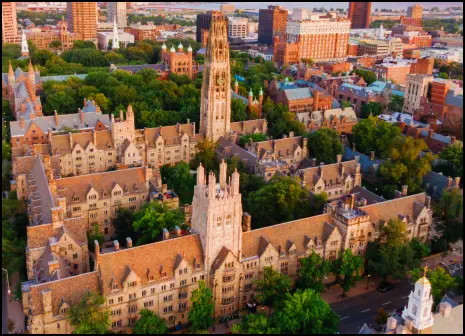
Yale University, founded in 1701 as the Collegiate School, was the most significant educational institution of
Connecticut Congregational churches. The college molded many religious leaders who became political leaders.
Ministers were not only called to duty on the Sabbath, but were the most powerful force in the Puritan community
at large. They were the politicians, the social overseers, and the teachers of the faith, ever present and seemingly all-
knowing.
Connecticut was able to retain an essentially undiluted Puritanism well into the eighteenth century due to England’s
“salutary neglect.” Although the British government periodically attempted to tighten control on the colony, its
efforts were usually short-lived. For a brief period from 1686 to 1689, Connecticut was part of the Dominion of New
England, but this ended with the deposition of James II during the Glorious Revolution. After 1689, Puritan
leadership in Connecticut was able to maintain itself without significant influence from Britain. This form of self-
government would become a crucial force in the growth of both Connecticut and the emerging American nation.
The most significant social and cultural change that came to Connecticut during the first half of the eighteenth
century was the Great Awakening. While the Puritans were strong believers in success through effort, they were not
strongly motivated by progress. Change was not sought, and improved material conditions mattered little in theory
compared to spiritual welfare. Personal comforts and enjoyments were insignificant in the sight of God. Reality often
countered Puritan ideals, however, which was a direct cause of the Great Awakening of the 1730s and 1740s. The
Great Awakening, led by such preachers as Gilbert Tennent, George Whitefield, and Jonathan Edwards, was a broad
religious movement that encompassed the middle and northern colonies. The “New Lights” who led the Awakening
called sinners to forgiveness and redemption. The prevalence of materialism in Connecticut as well as other colonies
provided rich fodder for the earnest sermons of repentance that the Awakeners preached to captive audiences in New
England meetinghouses. Connecticut parishes and the social fabric of Connecticut communities were disrupted by
the Great Awakening. The conflicts of the Great Awakening presaged the coming conflict of the American
Revolution.
THE AMERICAN REVOLUTION
Connecticut went through a series of changes during the revolutionary period that forever changed the course of its
history.
The events that brought the colonies to protest British rule were many. In the 1760s, Great Britain attempted to pass
a number of revenue-raising taxation measures, including the Sugar Act of 1764, the Stamp Act of 1765, and the
Townshend Duties of 1767. British authorities assumed that the colonists, while perhaps not enthusiastic about the
legislation, would remain loyal subjects of the Crown and accept Britain’s authority. It was soon evident, however,
that the British underestimated colonial resentment. A storm of protest arose over the imposed taxes, and Britain
became embroiled in a show of power to retain control.
Connecticut was, by this time, securely rooted in Puritanism and hostile to Anglican England. The colony was earlier
conditioned to self-government and economic independence, and refused to bow under British domination.
Merchants in the colony who were experiencing economic distress did not welcome the Sugar Act of 1764, which in
their view would curtail trade and further diminish profits. The Act called for trade with British merchants alone
and the end of trade with the French sugar islands. Connecticut merchants argued that the Act would profit Britain’s
island planters at the expense of the economic health of New England colonies such as Connecticut.
Britain not only refused to reconsider the Sugar Act, but also prepared to establish another revenue-raising legislation
with the Stamp Act of 1765. This act required that items such as licenses, newspapers, and legal documents carry
stamps available only from the British government. Protests of the Sugar Act were insignificant when compared to
the violent objections brought about by the Stamp Act. The Stamp Act protests, however, revealed that part of the
colony were against British actions while another part was willing to acquiesce. Towns west of the Connecticut River
generally accepted the Stamp Act. Colonials east of the river, however, refused to accept the new law. Governor
Thomas Fitch, of course, encouraged acceptance of the Stamp Act; he believed that protest would cease once the act
was implemented. Jared Ingersoll of New Haven took a similar stand. He reasoned that there would be less difficulty
over the measure if colonists enforced it, and he agreed to serve as the stamp distributor for Connecticut. Ensuing
newspaper assaults on Ingersoll paved the way for more forceful measures by Connecticut’s citizens. Leading the way
were protesters from New London, Norwich, Lebanon, and Windham. Ingersoll was condemned as an enemy to
American liberty, and he was hanged in effigy from trees in New Haven. Lebanon tried and convicted Ingersoll’s
effigy, which was dragged through streets while people lashed at it with whips, before burning it before a cheering
crowd.
The wrath of eastern Connecticut against Ingersoll and Governor Fitch was more than a difference of opinion with
westerners over the imperial issue. It was a reflection of the area’s frustration at having its interests and plans
undermined by western colonists throughout the eighteenth century. During the first half of the 1700s, for example,
the western area had come to conduct substantial business with the royal colony of New York, and the Anglican
Church had grown. Eastern colonists had had little contact with the mother country, however, and they were
economically underdeveloped and primarily rural. Economic division resulted in part because of rival views regarding
paper currency. As the seacoast towns in the east grew in the 1700s, their operations became impeded by a shortage of
money. Eastern merchants had long conducted overseas trade with merchants in Boston, Newport, and New York
who sought to establish direct contact with English traders to eliminate the costs of the middleman. Prospects of
direct trade with England remained dim as long as eastern merchants did not have sufficient funds to pay off
outstanding debts to Massachusetts, Rhode Island, and New York importers. The region’s response to the situation
was the formation of the “New London Society for Trade and Commerce.” The General Assembly was petitioned for
the opportunity to issue bills of currency based on mortgages deposited with the company. If this operation had been
successful, eastern Connecticut would have had an expanded supply of currency with which it could pay off past
debts and purchase goods directly from Britain. Western Connecticut, more populous and more powerful in the
colony’s General Assembly, successfully destroyed the New London Society, primarily because they were unwilling to
stand by while merchants from eastern Connecticut grew strong enough to become substantial competitors.
Bitterness between east and west Connecticut in the decades preceding the American Revolution was also caused by
religious strife that grew out of the Great Awakening. During the 1730s and 1740s serious divisions took place among
Connecticut Puritans as a result of this revival. In the east, the New Lights attacked the cold formality of traditional
Congregational preaching and introduced a personal spontaneity to worship. In the western region, Old Lights
denounced the religious worship of the New Lights and, because they were strongly enough represented in the
General Assembly, they passed a measure banning revivalist preachers from taking the pulpit in a congregation unless
permitted by the local preacher. In addition, east-west conflict in Connecticut was fueled because of division over an
eastern-Connecticut land company called the Susquehannah Company. This company claimed and sought to develop
thousands of acres of land in Pennsylvania along the Susquehannah River. The Penn family, alarmed at the potential
loss of a portion of the colony, protested to the Connecticut General Assembly as well as the King. Western citizens
also protested, fearing that the potential success of the proposed settlement in Pennsylvania would result in lower
prices for land in their area. The anti-Susquehannah faction in the west and the pro-Susquehannah faction in the east
became embroiled in a series of bitter speeches and pamphlets.
The Stamp Act controversy, therefore, was the venting of accumulated bitterness over a number of issues that had
divided Connecticut in preceding decades. Eastern Connecticut determination to oppose the Stamp Act was the
impetus that led them to bring about a political revolution within the colony.
In the summer of 1765, a group of Connecticut’s most influential leaders came together to organize an official
protest against the terms of the Stamp Act. Present were Eliphalet Dyer, lawyer and founder of the Susquehannah
Company; Jonathan Trumbull, a leading merchant and official in the General Assembly; and three militia officers
who had served in the French and Indian War on the side of the British: Major John Durkee, Captain Hugh Ledlie,
and Colonel Israel Putnam. The result of their meeting was the organization of the Sons of Liberty. This group had
two goals: to convince Connecticut freemen that their liberty could be secure only if the colony’s western Tory
leaders were weakened, and to organize the colony to elect “patriotic” leaders from eastern Connecticut. The
carefully drawn plan was rapidly executed and became successful even beyond the expectations of the men who had
created it.
The first task of the Sons of Liberty was to discredit Jared Ingersoll. In September 1765, after a forceful
demonstration, they demanded his resignation as stamp distributor. They then focused their energy on removing
Governor Fitch. Although the British had by this time withdrawn the Stamp Act because of fierce American
opposition, the easterners kept up the pressure. After employing energy and resources to elect a new governor in the
1766, their efforts resulted in the successful election of candidates William Pitkin as governor and Jonathan
Trumbull as deputy governor.
Eastern Connecticut’s victory in the 1766 election was by far the most important single event in the history of the
colony during the Revolutionary era. The election brought the easterners control of the Council, the upper house of
the Assembly, and the governorship, all of which was maintained throughout the entire Revolutionary period.
Eastern Connecticut’s rise to political power had a strong and lasting impact on British policy. In 1767, when
Parliament enacted the Townshend Duties, which provided for British taxation on colonial imports, Connecticut’s
leadership immediately mounted protests. The Sons of Liberty organized meetings in New London, Norwich, and
Windham to draw up plans for the non-importation and non-consumption of British goods. By 1769, Connecticut
merchants had become “educated” to respect the necessity of doing without the mother country’s merchandise.
Meanwhile Britain had repealed all of the 1767 duties with the exception of the tax on tea. The Tea Act of 1773 was
the final stage in the crisis between the mother country and America. The Sons of Liberty organized a boycott on tea
coming from the British East India Company, and ships carrying tea were prevented from docking at American ports.
In December 1773, Boston radicals dumped East India Company tea in Boston Harbor. The British Parliament,
clearly outraged by this American challenge to their authority, began a series of steps to regain control of
Massachusetts.
The Tea Act and resulting Coercive Acts against Massachusetts (1774) forced the people of Connecticut to choose
whether to support the King and Parliament or assist their comrades in Massachusetts. With Trumbull as Governor
of Connecticut and the easterners in command, the path of the colony was clear. The Sons of Liberty began a series of
fiery meetings to gain support of the Patriot position. Aid was promised to Boston. The First Continental Congress
in Philadelphia met in September 1774 to decide a course of action. Preparing for the worst, the Assembly ordered
intensive training of the militia and asked towns to double their supplies of powder, balls, and flints for muskets.
Any possible question of Connecticut’s course in the imperial controversy was answered in 1775 when word came of
the clash at Lexington and Concord. Connecticut moved strongly in support of the farmers who had clashed with
the British. With about 3,600 men, they drew weapons and marched to join the Patriot force gathering at
Cambridge. This immediate response of Connecticut was to be characteristic of their support of the American cause
throughout the American Revolution.
Once the war began, the General Assembly enacted legislation to eliminate any remaining Tories who would
undermine the efforts of the Patriots. The process of neutralizing those who gave support to the mother country was
so complete that any Loyalists who remained were either forced into grudging acceptance of the Patriot position or
into fleeing the state.
Connecticut’s political leadership remained stable throughout the years of the American Revolution. British forces
attacked the state four times during the war; the first three assaults resulted in considerable destruction of property
and provisions in Connecticut, but loss of life was minimal. The final battle of Trumbull and Griswold forts,
however, turned into a bloody massacre in which many American lives were lost.
Connecticut received recognition during the Revolution not only for its supply of troops throughout the effort, but
also for its rescue of American forces at two crucial times in the war; during the winters of 1777-1778 and 1779-1780,
when Connecticut supplied food and clothing to troops who were threatened with starvation and death.
Connecticut also made significant contributions in gunpowder and guns.
At the same time, however, some inhabitants regarded the war as an opportunity for personal gain and recognition.
Some merchants acquired wealth capitalizing on the needs of the military for meat, flour, grain, horses, and weapons.
Traders cornered the markets on materials required for the war effort and charged exorbitant prices. Nonetheless, by
1783, when the Patriots won the American Revolution, it was clear to all that the Connecticut colony had made a
major contribution to the achievement of American independence.
POSTWAR CONNECTICUT
At the end of the war in 1783, the United States went through a number of major changes. Connecticut, however,
remained true to its essentially conservative character in the years that followed.
One major reason for Connecticut’s smooth transition from a colony to an independent state was that it had always
been a self-sufficient corporate colony. The people of Connecticut continued the representative form of government
that had served its interests throughout the entire colonial period. The state adhered to its traditional framework.
Eastern Connecticut’s political and religious patterns continued to govern society. Puritan concepts of rule by the
political elite, and religious worship supervised by the established Congregational Church, continued to dominate.
Although the merchants of Connecticut suffered little hardship during the war years and afterward, small farmers in
the state suffered severe economic distress. At a convention at Middletown in September 1783, they challenged the
state’s nationalist-oriented Standing Order, but were defeated in their efforts to prevent stronger central government.
After the Constitutional Convention was completed in 1787 and the Constitution sent to the states for ratification,
Connecticut’s Standing Order waged a strong campaign for acceptance of the new form of government. Despite
continued opposition from the agrarians, the state’s nationalist-conservatives won an overwhelming victory for
ratification in Hartford on January 9, 1788, and Connecticut became the fifth state to ratify the Constitution.
Upon adoption of the Constitution and the subsequent formation of political parties, the state manifested its
conservative position by strong support of the Federalist Party. The party was seen as having the same respect for
authority on the national level as was true at the local level. The Federalist stronghold was maintained in the state
until 1817, mostly due to a restrictive system of selection for members of the Council and the General Assembly. Few
were willing to risk the wrath of the local Federalist and Congregational establishment by challenging their authority
and supporting Democrat-Republican candidates.
Although about eighteen hundred Connecticut men served in the American militia during the War of 1812,
Connecticut’s Federalist governor and assembly offered little support to the Madison administration’s war effort,
stating that it was an unnecessary war and should have been avoided. Democrat-Republicans lost no time in accusing
the Federalists of lack of patriotism; this translated into electoral gains. By the 1815 state election, Democrat-
Republicans had significantly increased their seats in the General Assembly.
The issue that enabled the state’s Democrat-Republicans to finally topple the Federalists from power, however, was
the disestablishment of the Congregational Church. Long a Federalist stronghold, it occupied a unique position in
the state; everyone, regardless of religious preference, was taxed to support it. Naturally, the result was that growth of
other churches was severely curtailed; non-Congregationalists, especially Baptists and Methodists, supported
Democrat-Republicans primarily for this reason.
The biggest break for Democrat-Republicans came in 1815 when the Episcopalians, who had been supporters of the
Federalist Party, failed to receive funds they thought due them from the Federalist-dominated General Assembly.
They quickly withdrew their support and associated themselves with the electoral effort in 1817 that defeated the
Federalists for control of the governorship and the lower house of the General Assembly.
With the long reign of the Federalists over, Democrat-Republicans called a state convention to frame a new
constitution for Connecticut. The Constitution of 1818 was ratified by a majority of the state’s voters, and the
Congregational Church for the first time became one of several competing Christian sects. The Constitution also
provided for liberalized suffrage requirements, established annual elections and legislative sessions, strengthened
prerogatives of the governor, and gave greater independence to the judiciary. In some areas, however, the Democrat-
Republican-dominated Assembly retreated into a reactionary posture. Funds for the aid of the poor and infirm were
decreased, and Connecticut’s education system suffered due to cuts in appropriation to the common school system.
Democrats (former Democrat-Republicans) dominated state politics in the late 1820s and early 1830s. Four
Democratic governors were elected; resolutions for an unrestricted franchise, the accountability of state officials,
specific terms of office for judges, and shifts in taxes to remove some burden from laboring classes, were enacted.
Other measures during the Democratic reign included altering restrictions on liquor sales, ending the exemption of
clergy from poll taxes, abolishing traditional prohibitions on recreation during public fast days, simplifying divorce
procedures, and abolishing imprisonment for debt. Yet the state’s Democrats were never able to stir the electorate to
achieve the broad suffrage and humanitarian reforms that the Jacksonian Democrats achieved in other states.
Although the Congregational Church lost its political stronghold in 1818, it still greatly influenced the approach to
life of a good portion of Connecticut’s population. People’s lives continued to revolve around the ways of the local
parish, and many of the Congregational laws that had previously operated were maintained. The ideal of Sabbath
observance remained relatively unaltered until the Civil War, and little emphasis was placed on progress. Although
other churches had gained a foothold in the state, including Episcopalian, Methodist, Baptist, Universalist, and
eventually Roman Catholic, the Congregational Church was still the dominant religious institution in 1850.
Connecticut began a tide of emigration in the 1780s that lasted into the 1840s. Many sons and daughters left the
state, primarily because the land had become insufficient to satisfy the demands of increasing population. They
traveled to destinations north, south, and west. A large number of emigrants also settled in the Berkshire country of
Massachusetts, in the state of New York, and in Ohio. While all of these areas benefited from the ambitious drive of
Connecticut pioneers, Connecticut itself lost generations of men and women who may have been a vitalizing
influence on the state’s otherwise conservative constituency.
Women experienced some changes in antebellum Connecticut. For example, in 1788 Connecticut women had the
opportunity to work in the first woolen mill at Hartford. Textile mills were one of the first industries to hire women.
This was especially helpful to war widows and needy women. In 1792, Sarah Pierce founded a school in her home; the
school was incorporated in 1827, and was called Litchfield Female Academy. It attracted students from all over North
America. Pierce also wrote textbooks and two of her better known students were Catharine Beecher and Harriet
Beecher Stowe. Her school closed in 1833. In 1843, Sarah Porter began a Farmington school. Her school eventually
became one of the more elite finishing schools for young women. Lydia Huntley Sigourney was a very well known
woman in Connecticut at this time. She was a schoolteacher who published a book called Traits of the Aborigines of
America (1822). This book was based on the explorations of Henry Schoolcraft in Arkansas and Missouri. Her
husband requested her to publish the book anonymously, which she did. She wrote other books, however, and in the
1840’s charged $500.00 for the use of her name.
CIVIL WAR
Sectional differences between the North and the South, present during the eighteenth century, degenerated into
political and military conflict during the nineteenth century. The Missouri Controversy, the Mexican War of 1846-
1848, the Compromise of 1850, the Kansas-Nebraska Act of 1854, the rise of the Republican Party, and the Dred
Scott decision of 1857 were ordeals of sectional disharmony that advanced American disunity and culminated in the
conflict between the North and South at Fort Sumter in April 1861. Connecticut responded to these events with
predictable faithfulness to traditional values.
The Puritan Congregationalists who supported the Patriot cause during the American Revolution, and who stood
for ratification of the U.S. Constitution in the 1780s, saw the United States as a vehicle for the realization of a nation
freed from the “Old World’s” corrupting influences. The American Union, based on such a conviction, had
significance that rose above mere political arrangement; it was a divinely ordained instrument for fulfilling the will of
God. During the expansion and prosperity of the nation in the first half of the nineteenth century, Connecticut
Yankees perceived the Union as a sacred trust to which they owed devotion and allegiance. By the time of the first
assault at Sumter in 1861, the men of Connecticut were ready to express loyalty to the national cause and join the
Union Army.
State sentiment was hostile to the institution of slavery. During and after the Revolution, many Connecticut blacks
had secured their freedom in exchange for military service. Connecticut’s black soldiers received the same pay as
other soldiers. Of even greater significance was legislation enacted by the General Assembly in 1782, which gave
African-Americans born after March 1, 1784 their freedom at age twenty-five. Legislation in 1790 was passed to end
slave trafficking completely in the state. In 1848, slavery was ended in Connecticut, and there were only twenty
African-Americans still in servitude.
As the North-South controversy heated up in the 1850s and exploded in 1861, the state maintained its antislavery
posture. It nullified the Fugitive Slave Act of 1850; supported “Free Soilers” in Kansas following passage of the
Kansas-Nebraska Act; and supported the antislavery Republican Party of the mid-1850s.
Connecticut’s strong distaste for slavery had both ideological and economic roots. In the late eighteenth century, its
citizens shared with a great many Americans, northerners and southerners alike, a realization that slavery was
incongruent with the natural-rights philosophy spelled out in the Declaration of Independence. At the same time
Connecticut’s antislavery posture did not carry with it any modification of belief in white supremacy that had
operated during the colonial period. In the first decades of the nineteenth century, the state had some eight thousand
African-Americans, most of whom were free, but Connecticut’s blacks still did not enjoy the same rights and
opportunities that many other citizens took for granted. African-Americans were denied educational opportunities as
well as equal access to employment, public accommodations, and transportation facilities. The majority found
themselves severely restricted from opportunities commonly accorded to other residents. This was especially true in
education. African-Americans were often barred from Connecticut schools, or isolated if they did attend; in some
cases, community residents withdrew their children or resorted to vandalism of institutions that allowed black
students. Any efforts to establish educational institutions specifically for African-Americans met with hostility.
Thus, the Civil War era saw Connecticut’s citizens functioning on the basis of pro-Union and antislavery sentiments
and, in direct conflict with this position, anti-black sentiments as well.
Connecticut’s support of the Republican cause was an outgrowth of northern indignation at passage of the Kansas-
Nebraska Act of 1854. With the Democratic Party in the hands of southerners or pro-southern politicians, the Whig
Party riding the fence on the slavery issue, and the Free-Soil Party weak and ineffective, antislavery northerners had
no venue to voice their anger at the Kansas-Nebraska Act’s passage. The 1854 Republican Party sought to end the
expansion of slavery, and this position allowed it to gain enormous numbers of antislavery Democrats, Whigs, and
Free-Soilers in the northern states.
There were still a number of Connecticut voters who would not accept the idea, however, that the South was
responsible for the war. They maintained that the war was caused by justifiable resort to arms by southerners who
were about to be deprived of their fair claims to the West by abolitionist Republicans. These Peace Democrats
demanded that the South be allowed to leave the Union in peace, or that the Union be reconstructed on the basis that
slavery be undisturbed in the area allowed by the terms of the Missouri Compromise.
Republican William A. Buckingham served as Connecticut’s governor through the war years. His election in 1858,
and his repeated reelections through 1865, allowed Connecticut to maintain its strong Union support throughout.
With Buckingham to oversee the state’s war effort, Connecticut made a major contribution to the Union victory.
Once it was known that troops were needed, Connecticut’s towns and cities held meetings to raise money and enlist
soldiers. Connecticut was so successful in this endeavor that instead of just supplying one regiment, it was able to
supply three. Towns were responsible for local management of the war.
Meanwhile when the state legislature met in May, the legislature appropriated $2,000,000 for military expenses.
Enlisted soldiers received additional wages, and the wives and children of volunteers got a monthly stipend.
Not only did Connecticut’s soldiers and sailors give testimony to their dedication to the Union, but its civilian
population also joined in supporting military efforts by establishing many volunteer societies. Blankets, clothing,
medical supplies, and food were collected for the men at the front. Any special needs of state troops resulted in major
efforts by organizations to meet them. Volunteers also aided needy families of men at the front or widows and
children who were left destitute.
Connecticut was a major producer of arms during the Civil War. Colt’s Armory, the Winchester Arms Company,
and Christian Sharps’ Rifle Company were major producers of rifles; smaller companies sprang up around the state
and turned out impressive numbers of weapons including muskets, breech-loading Kentucky rifles, carbines, and
bayonets made by the Norwich Arms Company, the Connecticut Arms Company, Ames Iron Works, and the Collins
Company. Hartford County was the center of the state’s ammunition industry, and included a number of shops that
manufactured powder and cartridges; the largest was the Hazard Powder Company of Enfield, with a twenty-five-
building complex producing twelve tons of powder per day.
Connecticut always met or exceeded its quota for troops during the war. At various times during the war there were
twenty-eight regiments of artillery, two regiments and three batteries of artillery, and one regiment and a squadron of
cavalry. Its volunteers totaled 54,882 men. Connecticut had casualties in the amounts of 1902 men killed, 3309 dead
from disease, and 410 men missing.
Women contributed to the war cause by volunteering in hospitals, however, the state was not very receptive to women
working in the hospitals. A group of women, who were from well-known families, including Harriet Terry and
Rebecca Bacon, had to fight for permission to nurse—authorities did not want young women to enter the hospitals
because of unpleasant “sights and sounds.”
MANUFACTURING DEVELOPMENTS
The post-Civil War period in Connecticut was a time of tremendous growth. Its manufacturing boom reflected the
general industrial thrust of America between the close of the North-South struggle and World War I. Manufacturing
expertise, which became highly developed during the war, provided the state with a firm base from which to move
ahead. Development of the New York, New Haven, and Hartford Railway enabled Connecticut to market products
nationwide. Enormous capital resources in the state facilitated manufacturing. Industrial progress was supported by
construction and factory work undertaken by a stream of immigrants between 1865 and 1914. Connecticut’s earlier
lack of economic growth had made it less than attractive to newcomers, but with the state’s expanding manufacturing
opportunities, a general increase in immigration across the nation filtered into Connecticut. Italians, Irish, Poles, and
French Canadians were the largest groups of foreign ancestry living in the state during the twentieth century. Italian
immigrants congregated in Hartford and especially in New Haven. Many came in the first few decades of the
nineteenth century, seeking higher wages and better jobs than they could hope for in their native country. They took
jobs in unskilled labor, skilled factory work, wholesale and retail foods, and the building trades; they were the
majority of the city’s barbers, cobblers, tailors, and musicians. Irish immigrants began arriving in the early nineteenth
century as well; their numbers significantly increased after the potato famine in Ireland in the 1840s. Poverty and
oppressive British rule brought many more. The state’s first Irish immigrants worked as weavers or spinners, or
secured unskilled and semiskilled jobs building Connecticut’s railroads and canals. By the latter half of the
nineteenth century, the Irish predominated among police, firemen, mailmen, trolley and bus drivers, and railroad
conductors. French Canadians first began arriving in Connecticut in the nineteenth century to escape from low
wages in lumbering and farming in Quebec. They settled especially in the northeastern part of the state, where they
became prominent in textile factories. Immigrants from Poland migrated to America during the early twentieth
century because of low wages and unstable political conditions in their country. They settled primarily in Middlesex,
New London, Tolland, and Hartford counties. While many of them went into factory work, more Poles went into
farming than did any other immigrant group.
Rapid industrialization and immigration transformed Connecticut from a rural to an urban state. In 1910, New
Haven and Bridgeport were the first cities to reach populations of one hundred thousand. Hartford and Waterbury
had populations over fifty thousand. Many other cities, including New London, Stamford, and Naugatuck, had
populations between ten thousand and fifty thousand. City streets were lined with a multitude of stores and banks,
and crowded with electric trolley cars.
Yet the changes resulting from expansion were not all positive. As in many other states during this era, urbanization
also brought with it the inevitable urban slums. Landlords who rented dark, filthy tenements milked working class
dwellers, especially the foreign-born. Often they shared common bath facilities with other families. Lacking
adequate air, light, and fresh food, they frequently fell prey to smallpox, cholera, typhus, tuberculosis, and diphtheria.
A United States Bureau of Labor survey in 1905 revealed that housing conditions in Hartford were worse than in any
other city of its size investigated. Such economic conditions contributed to a rising crime rate.
Another negative factor of the period was growing disharmony between capital and labor, especially after the Panic of
1873. Within a year, five hundred banks and sixteen thousand businesses nationwide had declared themselves
insolvent. In Connecticut, 1893 and 1894 were the most difficult years. Over fifty percent of the state’s
manufacturing establishments reduced workers’ wages, and many employees lost their jobs or had their hours cut.
The New York Stock Exchange also plummeted in 1893, bringing about a business paralysis that fostered widespread
unemployment. The problems in 1873 and 1893 brought about critical situations for the poor, even for those who
managed to retain their jobs because of falling wages. Many unemployed men became “tramps,” drifting into gang
life, drinking and stealing whatever they could. Strict vagrancy laws were ordered in many New England states.
Organized industrial resistance began at the same time. Railroad strikes and rioting became common in many states.
Although Connecticut did not experience the massive violence that took place in some other areas, a series of
alarming capital-labor conflicts began to surface as unemployment soared and wages fell.
The panics and difficult working conditions drove many Connecticut workers to unionize. The Knights of Labor,
and eventually the American Federation of Labor, were organized to advance the concerns of the labor class. Decades
of strikes resulted from worker grievances against employers who often were also struggling for survival.
Another outcome of expansion was a growing resentment by native Connecticut citizens toward immigrants. Not all
immigrants were looked upon with disdain. There was relatively little resentment toward those who came from
northern and western Europe, for these newcomers were primarily Protestant; they had similar religious beliefs,
education, and values as the state’s natives. Immigrants from eastern and southern Europe, however, had customs and
values very different from those of Connecticut’s native citizens. The Puritan Yankee was especially resentful of
Jewish and Catholic immigrants. From its beginnings, Connecticut’s Puritans had been militantly anti-Catholic; they
regarded the Catholic Church as nothing less than the devil’s instrument. The influx of Catholic immigrants did
little to change this mentality. With an established anti-Catholic, anti-labor Connecticut political establishment, a
number of proposed public relief projects that followed the Panic of 1893 were rejected by the state legislature.
Farmers also felt the repercussions of harsh economic times. Falling farm prices, deflation, high railroad charges, high
prices on manufactured goods, high interest rates, and natural disasters all drove the farmer into growing
indebtedness; many went bankrupt. In 1892, they began to lend their support to the newly organized Populist Party,
which demanded the free and unlimited coinage of silver as a device to increase the currency in circulation. The party
also demanded government ownership of the telephone, telegraph, and railroads; a graduated income tax; an eight-
hour day for workers; popular election of United States senators; and other legislative changes to benefit farmers and
workers. Between 1892 and 1896 thousands of Americans, especially southern and western Democrats, supported the
Populist inflationary demand of unlimited coinage of silver at the ratio of sixteen ounces of silver to one of gold.
Among those converted was William Jennings Bryan, who had been elected to Congress in 1890 and 1892. In the
months before the Democratic election in the summer of 1896, Bryan campaigned and won the Democratic
nomination for the presidency with his position on the silver issue. In Connecticut, however, Democratic reaction to
Bryan was less than enthusiastic. The party’s leaders were Yankee bankers, businessmen, editors, and professionals
who feared that silver, at sixteen to one, would reduce their total wealth. Many of Connecticut’s Democrats changed
party affiliation or refused to vote in the election.
Although Bryan lost the presidential election against McKinley, his nomination considerably weakened the
Connecticut Democratic Party. This was a blow from which the state did not recover for a generation. Many former
Democrats wound up as Republicans, with the result that Connecticut’s Republican Party, now led by Yankee
bankers, businessmen, editors, and professionals, were in charge from 1896 until the 1930s.
CONNECTICUT WOMEN DURING THE PROGRESSIVE ERA
During the late nineteenth and early twentieth centuries women made some gains in higher education, politics,
the arts, and literature. In 1889, Hartford Theological Seminary began admitting women. Yale opened its first
graduate departments to women in 1892. Finally, the state legislature mandated that the State Agricultural School at
Storrs admit women, however, no publicly funded liberal arts college accepted women. In 1893, the legislature gave
women the right to vote in school elections. Women used this right to oust a corrupt superintendent, and to
consolidate rural schools. The suffrage movement did not gain as much momentum as it could have during this time
because most of the suffrage conventions were held in Hartford, and the women of this area did not reach out to the
rest of the state. Most of the well-known women of the state during this time were authors and artists. Anna
Hempsted Branch published books in 1905 and 1910; and Mary Wilkins Freeman published A New England Nun
and Other Stories (1891). In 1899, Florence Griswold opened her home in Old Lyme, Connecticut to a group of
artists. This group eventually became known as the Lyme Art Colony. Female artists such as sculptor Bessie Potter
Vonnoh, and Matilda Browne resided there.
WORLD WAR I AND BEYOND
At the outset of World War I in 1914, the United States declared neutrality. By 1917, however, international events
had compelled Americans to support the Triple Entente of the French, Italians, and British against the Central
Powers of Germany, Austria-Hungary, and Turkey. When America officially entered the war in April 1917,
Connecticut was already involved through its firearms and munitions firms. The state’s arms manufacturers had
been steadily increasing production since 1915 to meet British and French war contracts. Once the U.S. was in the
war, Connecticut’s firearms industries turned to supplying American armed forces.
The war years brought great prosperity to Connecticut. As defense production increased dramatically, so did a
number of other products manufactured in the state. By the close of the war, four-fifths of Connecticut’s industries
were producing goods for military use. Hat factories in Danbury produced trainloads of hats for the military;
Manchester factories made silk for parachutes; and Middletown companies produced woven articles for the military,
including machine-gun and cartridge belts, haversacks, pistol holsters, canteen covers, and braid for goggles and gas
masks. Defense production brought prosperity not only to manufacturers, but also to the entire state. Thirty two
million dollars went into factory construction and expansion between the years 1914 to 1918.
Postwar Connecticut continued to thrive. Many industries enjoyed increased profits even after the war. By the
1920s, Hartford had become a leading manufacturer in the aviation industry through its production of air-cooled
airplane engines. Numerous other businesses produced specialty parts for aviation, automotive, and electrical power
industries. Mass production of Henry Ford’s motorcar changed American life in numerous ways. In Connecticut, as
in the rest of the nation, gas stations and gift shops sprang up along main routes; country inns lured vacationers;
people generally began to enjoy travel like never before imagined. Prohibition became a heated issue for Connecticut
in the 1920s. The Eighteenth Amendment was considered by some to be an invasion of individual rights by states
and, for a time, bootlegging was common in the state.
Ethnic problems escalated in Connecticut during and after the war years. Many Yankees blamed ethnic invasion as
the determining factor of increasing urban slums and industrial altercations. Germans were attacked in speeches and
the press during the war. Governor Marcus Holcomb created a Home Guard in March 1917 to protect the state. In
April of the same year, he set up a state Council of Defense to oversee all war programs in Connecticut. Republican
businessmen of Puritan Yankee ancestry dominated the council. The Council had a concerted effort to “Americanize”
foreign-born or second-generation residents. At the same time the State Council of Defense set up an
Americanization Committee to make patriotic citizens of aliens through education. At the end of the war, declining
production and consequent unemployment resulted in increased labor strikes; many Yankees pointed a finger at
immigrants as the force behind capital-labor conflicts. During the 1920s the Ku Klux Klan gained in strength.
Connecticut had about twenty thousand members in twenty-three chapters consisting of Yankees and Protestants.
Republicans dominated the General Assembly through the war years and after, primarily due to the Democratic
Party’s weakened position because of the silver issue. J. Henry Roraback, chairman of the Republican State Central
Committee in 1910, greatly influenced Connecticut politics until his death in 1937. Yankee businessmen and
farmers constituted the core of the party, and Roraback handpicked all state Republican candidates for office. The
drive for women’s political rights in Connecticut, begun in 1869 when the Women’s Suffrage Association was
established, was ignored by Roraback until the ratification of the Nineteenth Amendment. Only then did he move to
enlist women for the Connecticut Republican Party.
All through the period of World War I and the 1920s, Yankee-Republican domination maintained an unrelenting
conservatism that lacked balanced leadership. It produced a climate that limited progressive legislation and restricted
the possibility of integration of ethnic groups into Connecticut society.
THE GREAT DEPRESSION
The stock market collapse in October 1929 initiated a period of economic misery in America. Businessmen who had
prospered during the war years and the 1920s saw their enterprises and holdings wiped out. Thousands of farms
were foreclosed; banks collapsed; unemployment climbed to unbelievable levels. President Herbert Hoover and the
Republican Party adhered to a position of laissez faire and rugged individualism. During the 1932 presidential race
Democratic candidate Franklin Delano Roosevelt, promising a “New Deal,” won the election. President Roosevelt
instituted a myriad of programs to help Americans recover from the economic crisis: the Emergency Banking Act, the
Economy Act, the Civilian Conservation Corps, the Federal Emergency Relief Act, the Agricultural Adjustment Act,
the Tennessee Valley Authority Act, the Farm Credit Act, and the Social Security Act. Roosevelt helped put the
nation back to work and gave the Democratic Party much electoral success.
The Crash of 1929 and the resulting depression brought predictable economic consequences to Connecticut.
Joblessness soared; school budgets were slashed; unemployed workers demanded aid to the poor. Republican
orientation did little to aid the crisis; assurances that things would get better shortly were insufficient to calm an
increasingly difficult situation. In 1930, the state’s voters departed from traditional Republican leadership.
Wilbur L. Cross, serving as Connecticut’s governor from 1931 to 1939, brought the state’s Democrats back from
political isolation. Core supporters included urban workingmen and immigrants who had not previously supported
Connecticut’s Democratic Party. In 1933, Cross created the Emergency Relief Commission to seek Federal assistance
for the state. During the next six years, New Deal money helped the unemployed to work; provided $22,000,000 to
homeowners through mortgage refinancing assistance; and made $3,500,000 available to the New Haven Railroad for
new equipment and repairs.
Cross and other urban Democrats were able to secure significant progressive legislation in the General Assembly from
1931 to 1939. Republicans, aware that their position was weakened and not willing to accept their minority status as
permanent, began to move the party into a direction that was noticeably more liberal, less anti-labor, and more
willing to accept the role of federal and state government in planning and spending for social programs.
Connecticut’s new liberalism continued into the mid-1940s. Under Raymond Baldwin, Republican governor of the
state from 1939 to 1941 and 1943 to 1946, old-age pensions and workmen’s compensation were increased; minimum
wage laws were put into line with the Federal Fair Labor Standard Act of 1938; state employees received raises;
discrimination was forbidden in the state merit system; and an interracial commission was established to halt
discrimination. In the 1942 election, Clare Boothe Luce became Connecticut’s first congresswoman.
During World War II, Governor Baldwin encouraged an energetic undertaking for unity and cohesion in the state.
Many residents became involved in volunteer efforts to aid in the war effort. As it had during World War I,
Connecticut once again became involved in a booming economy. War contracts turned the state’s unemployment
situation completely around, as specialized manufacturing facilities expanded to meet the demands of the war.
Social problems during the war years included a rise in the divorce rate and juvenile delinquency. New workers put a
strain on existing housing, and an influx of blacks into Connecticut from New York, the Caribbean, and southern
states challenged the state to assimilate yet another group of newcomers.
POSTWAR CHANGES
Connecticut faced a multitude of challenges in the decades following World War II. Initially, cancellation of war
contracts caused severe drops in production; unemployment rose significantly; and family life underwent permanent
changes as a result of the weakening of traditional roles during the war years.
The economy rebounded during the late 1940s. Manufacturing, as well as service industries such as insurance
increased significantly. By the mid-1970s, more than thirty-five large insurance companies had their headquarters in
the Connecticut. Forty-six major corporations also moved their headquarters to the state by the 1970s, twenty of
which were listed in Fortune’s 500. Tourism also became an important part of the state’s postwar economy. Education
in Connecticut thrived as well, as students from across the country attended such preparatory schools as Choate,
Hotchkiss, Kent, the Taft School, and Pomfret. A number of universities and colleges, including Yale, Wesleyan, and
Trinity, expanded to provide students with a superior education. Successful women began new businesses. Lillian
Vernon began her mail order business from her home in 1951.
As in many other states in the nation, Connecticut’s cities underwent major changes in the mid-1950s as middle-class
whites began moving to the suburbs. Minorities and the poor made up most of the urban population after this shift.
In 1950, the state’s African-Americans won their first major political victory when E. A. Adams, Jr., was named to
Governor Chester Bowles’ staff; he was the first African-American to hold an administrative post in Connecticut.
Nonetheless, employment and educational opportunities were still limited for the majority of blacks in the state.
For the first time since 1876, the Democrats gained control of the General Assembly in 1959. In that year, the
General Assembly passed two laws of major importance. One abolished county governments; all necessary county
functions were transferred to the state government beginning in October 1960. Another revised local court systems;
beginning in 1961 all municipal court judges and justices of the peace were replaced by a Circuit Court system
composed of forty-four full-time judges. During the mid-1960s, a sixth Supreme Court Judge plus five Superior
Court and two Common Pleas Court Judges were added.
A number of projects in the 1960s and 1970s were designed to bring business back into Connecticut’s deteriorating
cities and revitalize them. Stamford undertook a project to establish major corporations in a 130-acre downtown area.
New Haven was rejuvenated by Richard Lee, the city’s mayor from 1953 to 1970, when he dedicated himself to
creating “a slumless city--the first in the nation.” A Citizens Action Commission was created to oversee the
transformation, and by 1965 Lee had secured more than a hundred and ten million dollars in urban renewal funds
from Washington. Projects such as Oak Street involved construction of an eighty-five million dollar complex and the
building of a multilane highway from the Connecticut Turnpike into downtown New Haven.
Hartford’s downtown transformation was supported by the Greater Hartford Chamber of Commerce, and backed by
the Travelers Insurance Company. By 1962, the city had constructed Constitution Plaza, with a television
broadcasting facility, a 315-room hotel, and four high-rise office buildings. A downtown civic center was added, as
well as new housing units, schools, parks, and more business facilities.
Nevertheless poverty among minorities and school segregation created conditions for an outbreak of racial violence in
1967, affecting cities all across the state. Bridgeport, Hartford, Middletown, New Britain, New Haven, New London,
Norwalk, Stamford, and Waterbury were affected by racial conflict. In 1969, race riots in African American and
Puerto Rican sections of Hartford were the worst in the city’s history.
During the 1970s Connecticut faced challenges from a number of social issues, including those of urban minorities;
internal conflicts as a result of the Vietnam War; nontraditional life styles by a restless youth population; growing
aspirations of women for fulfillment in business, politics, and professions; pollution of the environment; and the
struggles of city and state government to meet expanding needs for social services. Although Connecticut had the
second-highest per-capita income in the nation by 1985, more than a hundred thousand children were on welfare,
and thousands more were living below the poverty line.
Connecticut in the 1980s had not completely solved its minority issues. In 1989, the University of Connecticut had
seven incidents of harassment aimed at Jews, Asians, African-Americans, and homosexuals in a forty-day period. One
institution that hoped to solve the problem was Connecticut College. In 1989, in an effort to increase minority
enrollment and help motivate young students to succeed, the school invited two hundred Hispanic and African-
American junior-high students to the campus for a taste of academic and social life for three weeks during the
summer semester.
In recent decades Connecticut’s agricultural sector has declined as land values have risen. One important crop is
shade-grown tobacco, which thrives in the Connecticut River Valley. Cattle, milk, and cheese are the state’s main
livestock products. The manufacturing sector, dominated by high-tech and defense industries, produce submarines,
jet engines, and helicopters. Hartford remains the center of the nation’s insurance industry.
CONTEMPORARY CONNECTICUT
Economic issues continue to challenge Connecticut. In the past two decades, Connecticut’s leaders have begun
seeking reforms of to the state’s tax system. Two governors, Ella T. Grasso (1975-1980) and William A. O’Neill (1981-
1991), supported legislative measures to decrease the large deficit in state finances. In 1991, Connecticut’s state
budget deficit was reported at $2.4 billion. Governor Lowell P. Weicker proposed a plan to revive a state income tax
and cut the state’s sales tax. His proposed 6 percent income tax would have replaced the state’s taxes on capital gains,
dividends, and interest. He proposed as well a reduction in sales tax from 8 to 4.25 percent, a pay freeze for state
workers, and state employee layoffs. After strong opposition from the state legislature, however, Weicker’s tax plan
was vetoed. In the 1990s, due to recessions in finance, insurance, and real estate markets, the state was forced to
impose a tax on earned income for the first time in its history.
Connecticut’s population and industries have continued to grow at a rapid rate. In 1990, U.S. Census figures listed
Connecticut’s population at 3,295,669, a 6.1 percent increase from 1980 figures. In 1991, the state topped the list for
per capita income. Personal income figures averaged $25,881, a 1.9 percent increase from 1990 figures, far above the
U.S. average of $19,082.
Connecticut’s industrial base continues to expand. The predominance of defense-related industries has helped
Connecticut’s economy through several nationwide recessions. Manufacturing has increased significantly. Today
more than two hundred and fifty international businesses have either relocated or expanded operations in
Connecticut. Fabricating industries employ a large number of workers, and transportation equipment leads the list in
production. Connecticut companies manufacture nuclear submarines, helicopters, jet engines, firearms, hand tools,
ball bearings, optical instruments, brass items, electrical machinery, clocks, chemicals, printed materials, processed
food, pharmaceuticals, textiles, and cutlery and silverware. A number of major corporations maintain their
headquarters in the state. At the same time agriculture, forestry, fishing, and mining make up only a small percentage
of Connecticut’s economy.
The insurance and tourism industries are major contributors to the state’s economy. Most of the insurance industry
is centered at Hartford. Tourism brings in nearly four billion dollars annually. Connecticut’s preserved towns and
villages, resort areas, historical sites, and state and local parks attract many visitors.
Connecticut focuses many resources on educational and cultural institutions. The state has a number of prestigious
institutions of higher education. Topping the list is Yale University in New Haven. Among the State’s forty-eight
other schools are the University of Connecticut in Storrs; Trinity College in Hartford; University of Bridgeport in
Bridgeport; Connecticut College, the U.S. Coast Guard Academy in New London; and Wesleyan University in
Middletown. Connecticut has a number of museums, including Wadsworth Athenaeum in Hartford, Yale University
Art Gallery, Yale Center for British Art and British Studies, Peabody Museum of Natural History, New Britain
Museum of American Art in New Haven, Shoreline Trolley Museum in East Haven, American Clock and Watch
Museum in Bristol, P.T. Barnum Museum in Bridgeport, and the Connecticut Historical Society Museum in
Hartford. Libraries are located in the state capital as well as in other large cities. Several leading universities and
colleges, such as Yale, also have special libraries. State’s historical sites commemorating Native Americans or the
American Revolution include Fort Shantok State Park near Norwich; Groton Monument; Nathan Hale Homestead
in South Coventry; Henry Whitfield House in Guilford; Old State House in Hartford; Mark Twain Memorial, also in
Hartford; and Mystic Seaport in Mystic. Recreational activities are plentiful. More than one hundred state parks and
state forests are open to visitors, including Gillette Castle State Park in Haddam; Sherwood Island State Park in
Westport; Dinosaur State Park in Rocky Hill; and Hammonassett Beach State Park in Madison. Several large ski areas
and many beaches also attract visitors.
Knowledge Base for Connecticut Resources


Dictionary of United States History


Transcending the Past, Present and Future with Data Resources for Knowledge
© American Data Processing, Inc.